
Morning Habits
The Discipline of the Early Hour
What happens in the first ninety minutes sets the cadence for everything that follows.
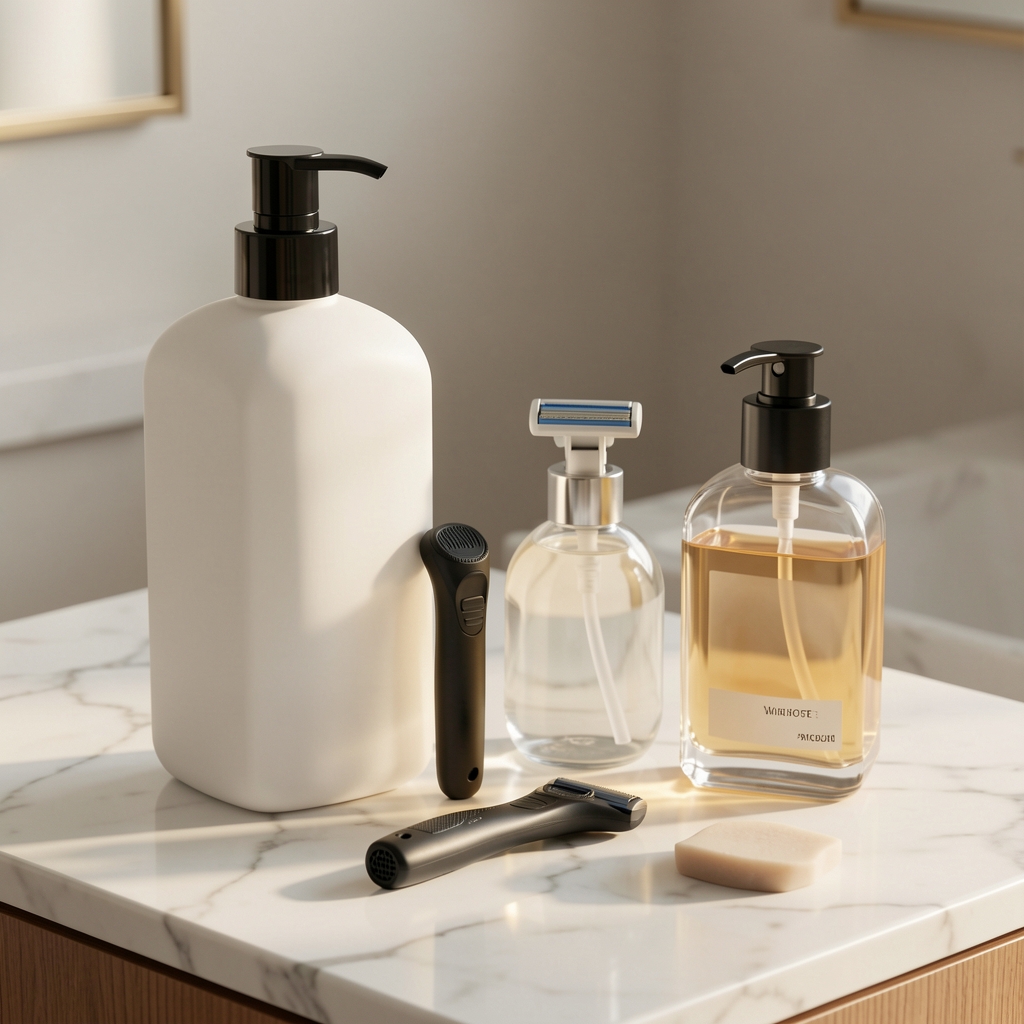
The phrase "personal care routine" tends to conjure either the austere — a bar of soap and nothing else — or the elaborate, a shelf of serums arranged by function and applied in a precise sequence. Neither is especially useful as a guide to daily practice. What the evidence from sustained grooming habits actually supports is something in the middle: a small number of reliable products, consistently applied, in a sequence brief enough that it is never skipped.
The grooming essentials that merit daily attention are not many. Across the range of what men actually use consistently — surveyed not by beauty editors but by the evidence of what remains on bathroom shelves after five years rather than five weeks — the list is short: a cleanser suited to skin type, a moisturiser with SPF for the morning, a plain moisturiser for the evening, a quality razor or trimmer, and a deodorant that actually works.
Everything else — serums, toners, eye creams, exfoliants — may have value in specific contexts, but they are additions rather than foundations. A man who begins from this minimum and adds one thing at a time, assessing whether it actually changes anything over four to six weeks, will arrive at his personal care routine by accretion rather than by purchasing everything at once and abandoning most of it within a month.
The skincare basics that do the most work are, in order: consistent cleansing, consistent hydration, and consistent sun protection. The third is the one most consistently neglected by men. Sun protection applied daily from thirty onwards makes a measurable difference to skin quality in the decade that follows. It requires no particular conviction or expertise — only the habit of reaching for it.
"A small number of reliable products, consistently applied, in a sequence brief enough that it is never skipped."
— Oranel Review, March 2026
The question of how to shave — razor, safety razor, electric trimmer, or some combination — is one where individual preference, skin type, and face shape interact in ways that resist a single correct answer. What can be said with confidence is that the investment in a good razor, whatever its format, pays returns that the investment in a budget alternative does not. The cheap cartridge razor is the false economy of the grooming shelf.
The broader grooming routine around shaving matters as much as the blade itself. A pre-shave warm wash, a quality shaving product — whether foam, gel, or soap — and a post-shave application that calms the skin rather than aggravating it: this sequence takes four minutes and produces skin that is consistently in better condition than the man who shaves dry over a sink at speed.
The beard, if maintained, requires its own vocabulary: a quality trimmer, beard oil or balm for those with coarser growth, and the discipline of a consistent trim schedule rather than the accumulated oversight that produces the mid-length face. Neither the clean shave nor the maintained beard is a superior choice. The superior choice is whichever is maintained with enough consistency to look deliberate.

The considered kit — five items, consistently used, in a workspace kept clean.
Seasonal wardrobe planning is, at bottom, a logistics problem. Men who find themselves wearing the same items repeatedly while others accumulate unworn at the back of a wardrobe have not made a style error — they have made a systems error. The wardrobe is not organised in a way that makes good choices easy.
The seasonal wardrobe review — conducted twice a year, spring-to-summer and autumn-to-winter — is not a fashion exercise. It is an inventory exercise. What is worn? What is not? What is worn because it is good, and what is worn because it is simply accessible? The wardrobe that has been edited down to the items that actually work — that are appropriate for the man's actual life, not a hoped-for version of it — requires less space and produces better daily outcomes.
The modern gentleman's wardrobe is not a collection of expensive items. It is a collection of reliable ones. A coat that works in Vienna in November. Trousers that fit correctly rather than approximately. Shirts whose collar sits properly. Shoes that are maintained rather than neglected. The investment in care — in polishing, in proper storage, in the occasional repair — extends the life of each item and reduces the ambient cost of appearing well-kept.
The purpose of a personal care routine — of the grooming practice, the considered wardrobe, the maintained skin — is not vanity in the pejorative sense. It is attention. A man who attends to the surface of his life with the same considered intention he applies to his work or his physical practice is not performing for others. He is maintaining standards he has set for himself.
This distinction matters because it changes the motivation structure. A grooming practice maintained for external approval tends to falter when no one is looking. A grooming practice maintained as a form of self-regard tends to persist — not because the man is obsessed with appearance, but because the practice is embedded in a broader personal standard, and departing from it would require a decision in a way that maintaining it does not.
The modern gentleman's guide, in this sense, is not a guide to style. It is a guide to consistency. The well-kept man is not the man who owns the best products or the most considered wardrobe. He is the man whose standards for himself — applied quietly, without announcement, across the ordinary days of the year — produce the cumulative impression of a life attended to.

Jasper Pembroke is a guest contributor to Oranel Review, writing on grooming, personal style, and the material culture of everyday life. He works as an independent writer and consultant based between Vienna and London.
More from Oranel Review